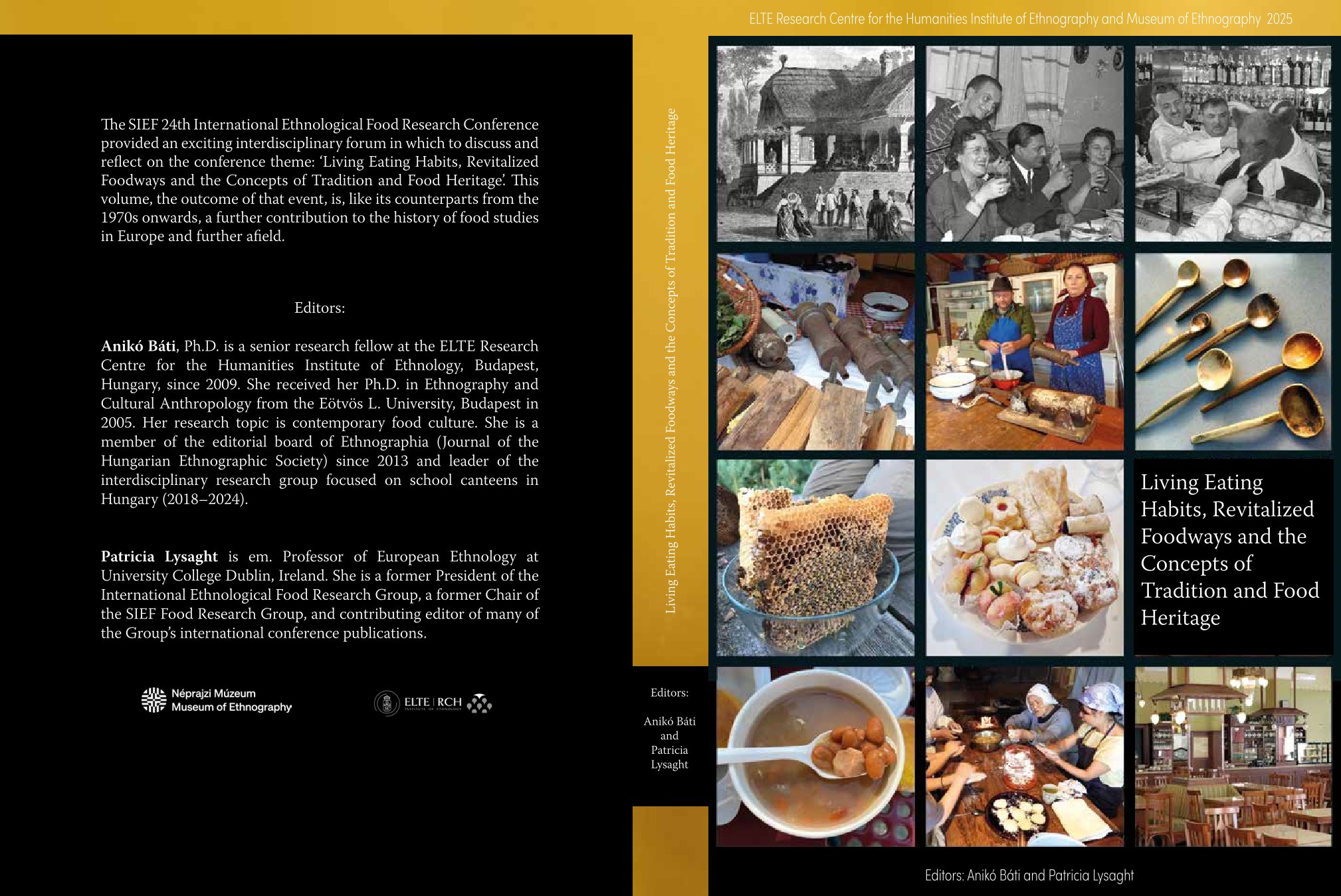
This interdisciplinary collection of articles, produced within the framework of the International Ethnological Food Research Group, explores the theme of ‘Living Eating Habits, Revitalized Foodways and the Concepts of Tradition and Food Heritage’. The volume, like its counterparts from the 1970s onwards, is a further contribution to the history of food studies in Europe and further afield.

ISSN 978-963-416-520-0 (Print) • ISSN 978-963-567-084-0 (Online)
DOI: https://doi.org/10.61380/978-963-567-084-0
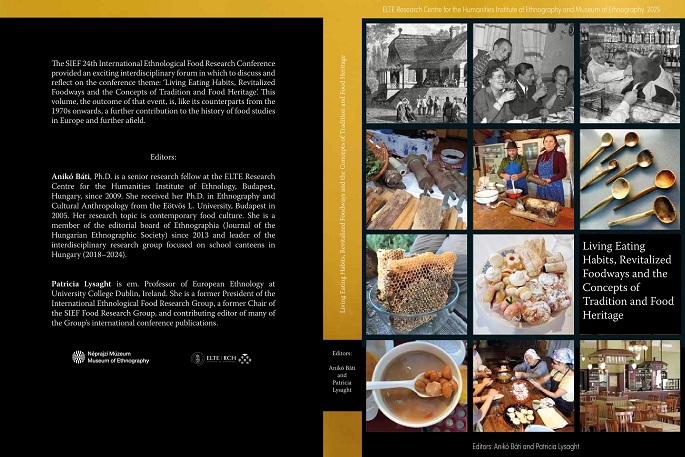
Click to enlarge image!
The images on the cover are illustrations from the studies in the volume.
Editors: Anikó Báti and Patricia Lysaght.
This publication was produced with the support of the Book and Journal Publishing Committee of the Hungarian Academy of Sciences.
|
PART I: DEALING WITH FOOD IN INSTITUTIONS AND ORGANISATIONS WORKING WITH CULTURAL HERITAGE I
|
|
Hiroko Nakazawa: Effects of the Designation of Yakimochi as an Intangible Folk Cultural. Property in Japan
|
|
PART II: FOOD AND FOODWAYS AS HERITAGE-MAKING: LOCAL DEVELOPMENT STRATEGIES AND TOURISM
|
|
Silke Bartsch: Regional Food and Ethnic Identity: Discourse on the Potential of Regional Food Campaigns
|
|
Karin Vaneker: Cross-border Cuisine: Food Culture and Heritage in the Euregio
|
|
Regina Sexton: When One Story Will Do: The Heritagisation of Wild Garlic in Ireland
|
|
Naoto Minami: Protecting and Promoting Traditional Food Culture in Contemporary Japan: Registration of Food Culture as a Cultural Property with the Agency for Cultural Affairs
|
| PART III: THE MANIFOLD MEANINGS OF FOOD AND HERITAGE |
|
Pál Géza Balogh: ‘Why are we stuck at the level of gomolya in cheese-making?’ The Carpathian Basin Dairy Heritage and Modern Artisanal Cheese-makers
|
|
Maja Godina Golija: Baking the Christmas Bread, Poprtnik, in Svibno, Slovenia: A Living and and Ambiguous Food Heritage
|
|
Sarah Shultz: Contesting a Changing Community with Traditional Foods: Race, Class, and Hot Chicken in Nashville, Tennessee, US
|
|
Yrsa Lindqvist: Food Recipes as Cultural Heritage and Historical Source
|
|
PART IV: GENDER, IDENTITY, ‘INVENTION’ AND FOOD HERITAGE
|
|
Olga Orlić: Foodways, Identity and Selective Tradition in Žrnovo: Representative and Forbidden Food
|
|
Levente Szilágyi: Strudli: Identity, Ethnicity and Representation among the Swabians of Szatmár
|
|
Csaba Mészáros: The Taste of Fat. Nourishing More than just the Body in Yakutia
|
|
Kristen Autret and Christopher Hollander: Adapting Traditions to Climate Change: The Impact on Indigenous Food Systems in the North American Arctic
|
|
Rogéria Campos A. Dutra: The Culture of Milk in the Rural Southeast of Minas Gerais, Brazil
|
|
Taija Kaarlenkaski: National Milk. Gender and Finnishness in the Milk Promotion Strategies of the Finnish Dairy Nutrition Council
|
|
PART V: ETHNIC, LOCAL AND TRADITIONAL FOOD: MEANINGS IN A COMPARATIVE PERSPECTIVE
|
|
Anikó Báti: Food as Messenger: On the Example of Slovak Cuisine in Hungary
|
|
Katalin Juhász: Food Heritage and Food Rituals as an Indispensable Element of Contemporary ‘Crossover Folk Customs’: The Example of Csömör (Hungary)
|
|
Ekaterina Protassova and Maria Yelenevskaya: Russophone Immigrant Foodways as Markers of Cultural Adaptation and Hybrid Identities
|
|
Zsolt Szilágyi: From Geriin Buuz to Fine Dining: The Changes in Mongolian Food Culture from the 1990s to the Present
|
|
PART VI: FOOD HERITAGE IN TIMES OF CRISIS
|
|
Håkan Jönsson: Restrictions as Culinary Heritage: A Study of Restaurant Politics in Sweden
|
|
Agnieszka Pawłowska-Mainville: Harvesting Gold from Trees: Tree-beekeeping as an Element of Forest Food Systems and Culinary Heritage in Poland
|
|
Antonia Matalas and Anastasia Ntantou: Health Claims for Traditional Fermented Foods
|
|
James I. Deutsch and Fae R. Rauber: Foodways in the Hobo Jungles: Heritage and Tradition among the Unhoused in the United States in the Late Nineteenth and Early Twentieth Centuries
|
|
PART VII: DEALING WITH FOOD IN INSTITUTIONS AND ORGANISATIONS WORKING WITH CULTURAL HERITAGE II
|
|
Zsuzsanna Nagyné Batári: Food Heritage in an Open Air Museum Context: Research, Representation and Interpretation: A Case Study of the Hungarian Open Air Museum
|
|
Fruzsina Arkhely: Gastronomy as Intangible Cultural Heritage: The ‘Miller’s Wafer’ Tradition in Borsodnádasd
|
|
Erika Vass: The Food Heritage of the Transylvanian Armenians
|
|
Zoltán Ottó Fülöp: An Exhibition to Quench Cultural Thirst: The Soda Water Collection at the Szeged Water Tower from the Perspective of the Heritagisation of Gastronomic Goods
|
|
VIII. LIST OF CONTRIBUTORS
|
|
IX. INTERNATIONAL COMMISSION FOR ETHNOLOGICAL FOOD RESEARCH
|
|
Maja Godina Golija: Three successful and fruitful decades of work: Professor Patricia Lysaght as President of the SIEF Food Research Working Group
|
|
International Commission for Ethnological Food Research: Conferences, Themes and Publications (1970–2025)
|
The entire volume can be downloaded here (Pdf).